Geometry Lighting Assembly
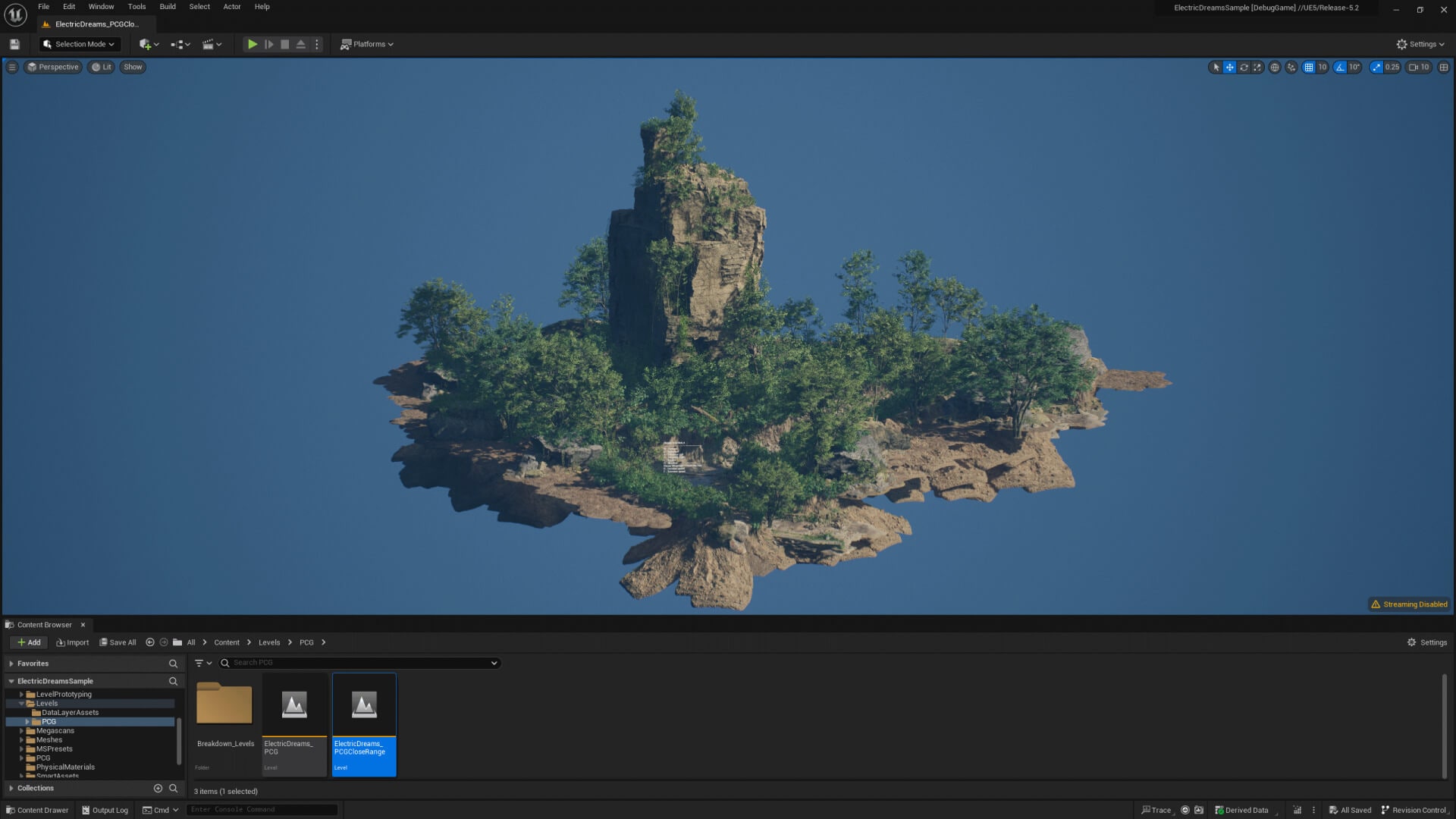
Supplied Electric Dreams artwork, used as an environment reference; not a Nanite benchmark. Field guide / Source checked
Nanite: geometry is only one budget Nanite stores geometry in hierarchical clusters and streams visible detail at changing levels of detail. Epic describes it as a virtualized geometry system; it does not remove every scene cost.
Epic explicitly calls for measurement of material complexity, output resolution, instance counts and hardware performance. Our review prompt: compare a representative assembled scene on the intended device, not only an isolated hero asset.
EDITORIAL WORKSHOP / 12 DISCIPLINES
Name the handoff. ART / Environment art Owns Modular kits, material language, landmarks, composition, and the authored exceptions that keep procedural worlds from feeling mechanical. Handoff World building, lighting, technical art, level design, and performance budgets meet at the playable assembly—not in isolated beauty renders. Review prompt Readability at traversal speed; material count and overdraw; collision; HLOD behavior; memory by region; variation without visual noise. TECH ART / Technical art Owns The bridge between visual ambition and measurable runtime cost: shaders, tools, rigs, procedural graphs, validation, and content rules. Handoff Turns profiler evidence into artist-facing constraints and turns repeated manual work into inspectable tooling. Review prompt Representative captures on target hardware; failure-state visualizers; deterministic tools; versioned presets; a named owner for every automation. LIGHT / Lighting Owns Exposure, motivation, hierarchy, atmosphere, reflections, and the visual route through a scene or shot. Handoff Works with environment materials, camera, VFX, gameplay readability, Lumen proxies, and platform scalability as one system. Review prompt Surface Cache coverage; emissive noise; exposure transitions; reflection sources; shadow cost; worst-case combat and camera cuts. CODE / Gameplay engineering Owns State, authority, replication, save boundaries, performance-critical paths, and stable interfaces between systems. Handoff Blueprint iteration and C++ control become a designed boundary. Neither is a badge of seriousness; both need ownership and tests. Review prompt Network authority; rollback assumptions; deterministic state; save compatibility; hot-path traces; failure recovery in packaged builds. DESIGN / Systems & level design Owns Rules, pacing, encounter grammar, player communication, spatial affordances, and the feedback loops that make content legible. Handoff Shares world partition, navigation, streaming, AI, telemetry, camera, and performance constraints before greybox becomes expensive. Review prompt First-time comprehension; edge-case state; systemic combinations; route legibility; encounter reset; accessibility and input alternatives. ANIM / Animation Owns Motion language from locomotion and combat to facial performance, retargeting, Control Rig, and shot cleanup. Handoff Capture, rig, gameplay state, camera, physics, audio, cloth, and editorial timing all shape whether a performance survives into final pixels. Review prompt Foot contact; root motion; pose continuity; retarget drift; eye lines; cloth and groom cost; LOD transition; interruptibility in play. VFX / VFX Owns Timing, shape, hierarchy, simulation, material response, and the information carried by particles, fluids, destruction, and screen-space effects. Handoff Effects sit inside combat readability, lighting, audio, camera exposure, translucency, and GPU budgets—not on top of them. Review prompt Overdraw; bounds; spawn spikes; pooling; scalability; visibility against every biome; networked triggers; photo-sensitivity concerns. AUDIO / Audio Owns Spatial information, performance, feedback, ambience, mix hierarchy, MetaSounds systems, and the sonic continuity of a world. Handoff Audio cues depend on gameplay state, animation events, physical materials, streaming, cinematics, and accessibility decisions. Review prompt Voice concurrency; virtualized sources; dynamic range; localization; subtitle timing; state recovery; platform output formats; memory residency. CAMERA / Cinematics & camera Owns Lens, blocking, camera motion, edit rhythm, shot continuity, Sequencer structure, and final-pixel intent. Handoff Moves between gameplay, animation, lighting, performance capture, Movie Render Graph, nDisplay, color, and editorial metadata. Review prompt Lens metadata; versioned takes; frame handles; motion blur; exposure; temporal artifacts; camera collision; gameplay-to-shot transitions. BUILD / Build & release Owns Cook, package, patch, crash symbols, device profiles, platform compliance, deployment, and reproducible release candidates. Handoff Makes every content and code decision confront a real install, real patch size, real hardware, and an accountable rollback path. Review prompt Clean-machine build; deterministic cook; shader and PSO work; chunking; save migration; install/boot tests; telemetry and crash triage. LIVE / Live operations Owns Content cadence, economy, moderation, analytics, experiments, rollback, incident response, and player communication after launch. Handoff Connects backend state, patch systems, UGC governance, store surfaces, creator tools, and community trust. Review prompt Kill switches; migration safety; abuse paths; entitlement recovery; cohort integrity; rollback speed; clear owner and public status copy. EDU / Education & enablement Owns The learning sequence, examples, documentation, mentorship, and the path from feature familiarity to a finished artifact. Handoff Pairs concepts with project files, profiler evidence, source control habits, critique, packaging, and reflection on tradeoffs. Review prompt Learner can reproduce the result; examples expose failure cases; terminology stays current; projects end in a packaged build, not a tour.